
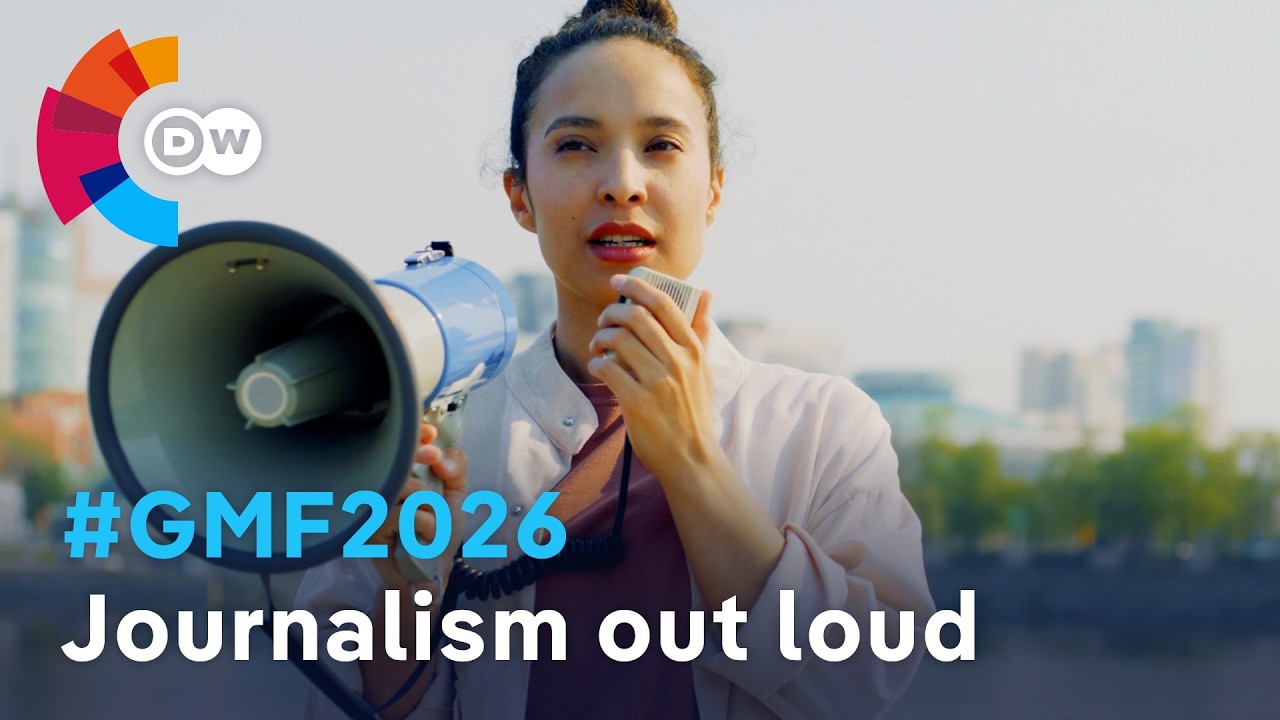
Journalism out loud | DW Global Media Forum 2026

Journalism out loud | DW Global Media Forum 2026
At a time when facts are challenged and independent voices are suppressed, journalism must remain visible and heard.
📢 Under the motto "Journalism out loud," media professionals, decision-makers, and experts from around the world will gather on June 23–24, 2026, to explore the future of journalism in an era of restricted press freedom, artificial intelligence, and big tech influence.
How do we protect democratic dialogue in polarized times?
How do we counter disinformation in the age of AI?
📅 June 23–24, 2026
📍 World Conference Center Bonn, Germany
➡️ Stay tuned for updates on our speakers, agenda, and special events.
#GMF26 #MediaConference #JournalismOutLoud
Disinformation in the Philippines | GMF Talk with Celine Samson
"There is not a lot of confidence among people in their skills to identify what is fact from what is fake."
In this episode of #GMFTalk, we sit down with Celine Samson, fact-checker at VERA Files—the leading Philippine non-profit newsroom renowned for its rigorous fact‑checking.
She breaks down why the country has become a testing ground for new disinformation tactics, how her team works to debunk false narratives, and more.
#factchecking #disinformation #VERAfiles #GMF26
Keeping journalists and their sources safe in the digital age | GMF Talk with Isabela Fernandes
"The worst that can happen for a journalist is to put the source in jeopardy."
For more than two decades, The Tor Project has been at the forefront of building free, open‑source tools that protect anonymity online. Its privacy technology has become indispensable for media professionals working under pressure, from reporting in hostile environments to communicating securely with sources whose safety depends on staying invisible.
For #GMFTalk, we spoke with Executive Director Isabela Fernandes about Tor’s mission, why it matters so deeply for journalists, and the common pitfalls people still face when it comes to digital security.
A crucial conversation on why privacy isn’t optional — especially when the stakes are high.
What examples of resilience in Iranian civil society affect your reporting?
We asked Niloofar Gholami from DW's Farsi Service: What examples of resilience in Iranian civil society affect your reporting?
--
When Iran's regime shuts down the internet, it doesn't just silence protesters, it blocks the world's view into the country. With communication severely restricted, independent reporting becomes a daily challenge, and journalists must rely on a handful of fragmented sources to understand what is happening on the ground. #GMF26 #JournalismOutLoud
What makes reporting on Iran from abroad responsible and constructive?
When covering Iran from the outside, what should responsible and constructive reporting look like? We asked Niloofar Gholami from DW’s Farsi Service to share her perspective.
--
When Iran's regime shuts down the internet, it doesn’t just silence protesters, it blocks the world’s view into the country. With communication severely restricted, independent reporting becomes a daily challenge, and journalists must rely on a handful of fragmented sources to understand what is happening on the ground.
#GMF26 #JournalismOutLoud
How do you see the future of media and communication in Iran?
How do you see the future of media and communication in Iran? That’s what we wanted to know from Niloofar Gholami (DW Farsi Service).
--
When Iran's regime shuts down the internet, it doesn’t just silence protesters, it blocks the world’s view into the country. With communication severely restricted, independent reporting becomes a daily challenge, and journalists must rely on a handful of fragmented sources to understand what is happening on the ground.
#GMF26 #JournalismOutLoud
How do you report from Iran under internet shutdowns and restrictions?
When Iran's regime shuts down the internet, it doesn’t just silence protesters, it blocks the world’s view into the country.
With communication severely restricted, independent reporting becomes a daily challenge, and journalists must rely on a handful of fragmented sources to understand what is happening on the ground.
We spoke with Niloofar Gholami from DW's Farsi Service and asked her:
How do you report from Iran and fact-check events under internet shutdowns and restrictions?
#GMF26 #JournalismOutLoud
#GMF26: Save the date!
On June 23 and 24, 2026, the DW Global Media Forum #GMF26 returns to the World Conference Center Bonn, and we cannot wait to welcome you!
🌐 For many journalists and media professionals, the GMF is more than a conference. It is a place to meet colleagues from around the world, exchange experiences, find new partners for collaboration, and foster meaningful professional networks.
In a moment when polarization is rising in politics, society, business and technology, these direct conversations matter more than ever. It is time for #JournalismOutLoud.
👉 If you want to be part of a community of more than 1,000 participants from over 120 countries, mark your calendar and subscribe to our YouTube channel for updates.
Big topics, inspiring speakers, real dialogue - we hope to see you there!
Protecting journalism in a polarized world | GMF Talk with Jodie Ginsberg
"Exile is one of the fastest growing areas of need for journalists worldwide," observed Jodie Ginsberg, Chief Executive of the Committee to Protect Journalists. Her statement reflects the growing risks and instability faced by media professionals globally.
In this #GMFTalk, Jodie shared her perspective on these critical issues and explored some of the most urgent questions for journalism today including:
🔹 How can networks be strengthened to improve journalists' safety?
🔹 What does it take to defend free expression under pressure?
🔹 And how can media rebuild trust in deeply polarized societies?
Venezuela: What do the recent developments mean for journalists on the ground?
We spoke with Valentina Aguana, a digital rights activist based in Venezuela who spoke at #GMF25. She points out that the situation for journalists in the country has remained highly restrictive even after shifts in the political landscape linked to the US operation. Media outlets remain heavily censored by the government and journalists are still facing repercussions for their work.
She shared her perspective with us.
#PressFreedom #JournalistSafety #DigitalRights #GMF26
#GMF26: Mark your calendars!
As 2025 draws to a close, it's time to plan for what's next!
👉🗓️ So, media professionals, mark your calendars: the DW Global Media Forum 2026 returns to the World Conference Center Bonn on June 23–24!
Let's stay connected! Follow us here (if you don't already) or subscribe to our newsletter to get all the latest updates on #GMF26: http://dw.com/p/3iRF7
Protecting information spaces and keeping up with digital shifts | GMF Talk with Carl Miller
How do we protect our information spaces and democracies from manipulation in an era of AI and information warfare?
Carl Miller warns: "Autocracies, whether it's China, Russia, Iran or many others see these spaces that we've created, whether that's social media platforms, whether that's Wikipedia, whether that's kind of smaller, more specialized forums – as vulnerabilities of liberal democratic institutions and ways of life."
From social media platforms to Wikipedia and niche forums, these spaces have become battlegrounds for influence. The challenge isn’t just stopping lies – it's understanding the deeper strategies behind information operations that target trust, belonging and identity.
In this GMF Talk, Carl Miller explores:
🔹Why newsrooms are losing their pedestal in the attention economy
🔹How democracies can build resilience against malign influence
🔹The next big power shift: large language models and their role in shaping public understanding.
Dive into the conversation 📽️
Error 400: API key not valid. Please pass a valid API key..
Domain code: global
Reason code: badRequest
