


The complete post is available where it was originally published on this site
SEO is shifting from a two‑pole model—optimizing for Google and writing for humans—to a tri‑engine ecosystem where AI agents (ChatGPT, Perplexity, Claude, Gemini) autonomously explore, synthesize, choose citations, and redirect demand. Echoing Google’s ZMOT, buyers now add AI assistants to their pre‑purchase research, using them for validation alongside reviews, comparisons, and social proof.
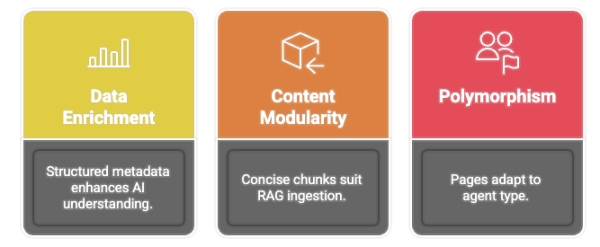
In this new paradigm, Google remains the search engine and people the virality engine, but AI systems have become a distinct traffic engine with their own selection criteria. Winning visibility therefore requires Agentic SEO: structured, dynamic content built for both indexes and conversational models. Its pillars are (1) data enrichment (Schema.org, microformats, semantic tags) to improve grounding and extraction, (2) content modularity—concise, chunkable blocks tailored for RAG ingestion, and (3) polymorphism—page variants tuned to the needs of different agents (e.g., shopping vs. medical).
Generative SEO and Edge SEO laid the groundwork, but static generation and conventional A/B tests cap impact. The breakthrough is Agentic Edge SEO: adaptive systems that modify content in real time based on user intent signals, SERP seasonality, and Core Web Vitals, continuously testing variants and promoting those that maximize CTR, ranking, and conversion. Examples include ecommerce pages that self‑evolve with trends and stock, city pages for car rental that shift by season, “living” news articles auto‑refreshed with breaking updates, and promo‑code hubs that reconfigure for events like Prime Day and Black Friday.
The mandate: move from page thinking to adaptive systems. Teams that master Agentic SEO will gain advantage as AI reshapes attention.
Key takeaways:
- AI agents have become a third, autonomous traffic engine alongside Google and human virality.
- Agentic SEO prioritizes structured, dynamic content for both search indexes and conversational AIs.
- Three pillars: data enrichment, modular “chunkable” content, and polymorphism by agent use case.
- Agentic Edge SEO adapts content in real time to intent, SERP shifts, and performance signals.
- Shift from static pages to adaptive systems delivers measurable gains in CTR, ranking, and conversion.